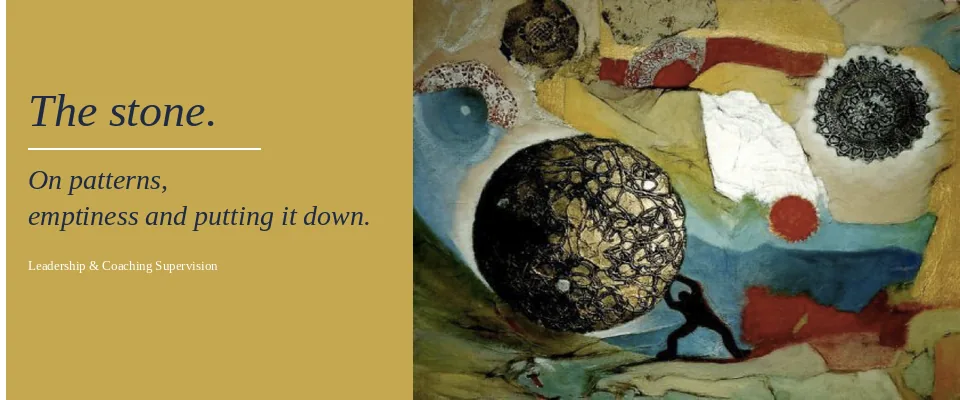
It is one of the oldest and most well-known myths in Greek antiquity. And perhaps one of the most recognisable.
Sisyphus was condemned by Zeus and Hades to an eternal punishment: pushing an enormous boulder up a hill. Again and again. All the way to the top — and once the stone has rolled back, he begins again.
And if I’m honest: I see Sisyphus everywhere.
The stone I keep pushing myself
Not as a punishment from the gods. But as a ‘groove’ I maintain myself. Do you recognise it?
We repeat patterns — with good intentions, mind you. And the remarkable thing is: we often know it.
Rolling the stone is familiar. Stopping is not.
Why we keep pushing
The stone serves a purpose. It gives grip. Direction. A reason to get up — even if not a particularly attractive one.
As long as you’re pushing, you know who you are. You’re the one who does this. The one who pulls, organises, solves, perseveres. Your identity is in the movement.
And then there’s something else: habit. The stone is heavy, but familiar. You know exactly how to hold it. You know the hill. You know the route. There is a certain safety in the known — even when the known exhausts you.
The emptiness
Change doesn’t just require will. It also requires imagination: what do I do when I put the stone down?
This is the part that few people say out loud, but almost everyone recognises.
That emptiness is uncomfortable. The question ‘what do I actually want?’ sounds simple. But for people who have spent years doing what was asked of them, what seemed logical, what they were good at — it is one of the most difficult questions there is.
And so they keep pushing. Not because they want to. But because sitting with that question feels heavier than the stone.
The real burden is not the stone. The real burden is not knowing who you would be without it.
What coaching can do here
A coach or a coaching leader doesn’t solve the stone or take it over. And doesn’t tell you what to carry instead.
We stand beside you on the hill and ask the questions you don’t ask yourself — because you’re too busy pushing.
Why this stone? How long? What would you see if you stopped for a moment and looked back? And what would you miss — really miss — if the stone were gone tomorrow?
Sometimes the answer is: nothing. Then that is the beginning of something new.
Sometimes the answer is: everything. Then that is also information. Then the conversation is about what is in that stone that nourishes you — and how you might find that in a different way.
In LCS, I look together with you at the patterns in your work as a coach or leader. Which stone do you roll? What keeps it moving? And what might become possible if you put it down — even just for a moment?
— Maaike Strack van Schijndel
Curious about Leadership & Coaching Supervision (LCS)?